
-
Empty cart
No products in the cart.
Return to Shop
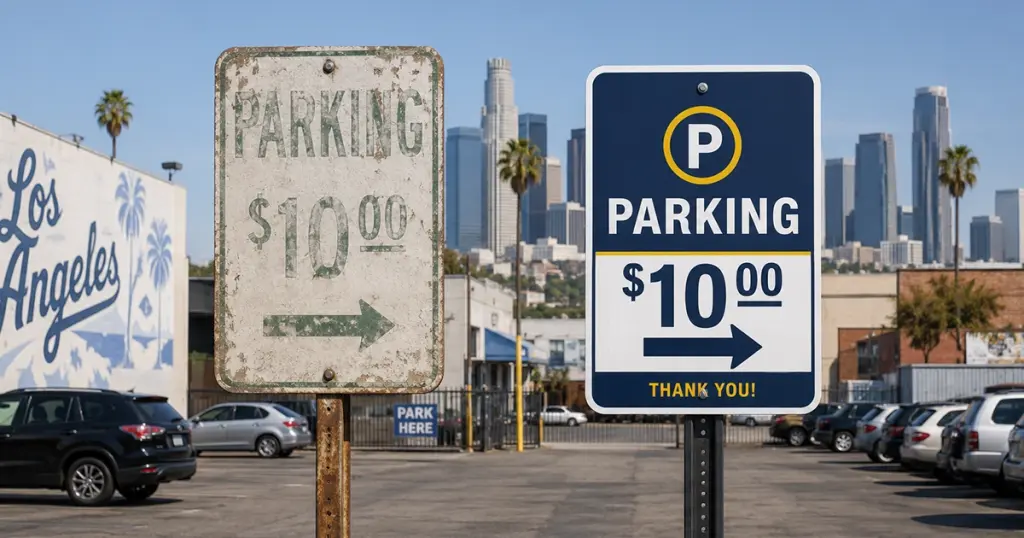
5 Signs Your Parking Signs Need to Be Replaced
Most property owners replace parking signs only when they fall off the wall. By that point, the sign has likely been unreadable for months — and depending on your situation, that gap may have already created legal or operational problems.
In California, a parking sign that can’t be clearly read is, for most practical purposes, the same as no sign at all. Whether you manage a commercial lot, a residential complex, or a restaurant with dedicated parking, here’s how to know when it’s time to replace your signs before they become a liability.
1. The Text or Graphics Have Faded
This is the most common — and most overlooked — sign of failure. In Southern California, UV exposure is intense year-round. Signs printed on lower-quality substrates — foam board, corrugated plastic, or standard aluminum sheet — can begin fading within 12 to 18 months of outdoor installation.
A faded sign creates two problems:
- Practical: Drivers genuinely can’t read it, which defeats the purpose of having it
- Legal: Under California law, signs used for parking enforcement must be clearly visible and readable. A degraded sign can be challenged as insufficient notice if a tow is disputed
What to look for: Stand at the point where a driver would first see the sign. If you have to squint, or if any part of the text is unclear, it’s time to replace it.
Every sign at Signify LA is built on MaxMetal® — not standard aluminum. MaxMetal is a composite panel: two aluminum skins bonded to a polyethylene core. Lighter, rust-free, superior vinyl adhesion, and a panel lifespan of 10+ years. It’s a deliberate upgrade — and it’s what sets our signs apart from everything else on the market.
MaxMetal® panels have a lifespan of 10+ years, and digital vinyl print lasts 2–4 years outdoors in LA conditions — significantly longer than standard aluminum or corrugated plastic. See our materials page →
2. The Panel Is Warped, Cracked, or Physically Damaged
Foam board warps within months. Corrugated plastic cracks under heat and impact. Standard aluminum sheet can oxidize and rust at the edges over time.
A physically damaged sign communicates neglect — to your customers, your tenants, and in a legal context, to anyone evaluating whether your property was properly maintained. Beyond appearance, a warped or cracked sign may no longer be mounted securely, creating a potential hazard if it falls.
What to look for: Any visible bending, cracking, splitting at the edges, rust spots, or separation of the panel from the mounting hardware.
MaxMetal® is 100% rust-free by design — aluminum composite doesn’t oxidize. Unlike standard aluminum sheet, there are no exposed edges that corrode over time. Learn more →
3. The Sign No Longer Reflects Current Rules
Rules change. Parking areas get reconfigured. New tenants have different needs. A towing company changes. Hours of operation shift.
If your sign says one thing and you enforce another, you’re exposed — both legally and in terms of tenant or customer relations. In a towing dispute, a sign that contradicts your actual policy is worse than no sign at all, because it suggests inconsistency or bad faith.
What to look for: Any sign where the posted rule, time restriction, contact number, or towing company information is no longer accurate.
Need to replace outdated signs? Browse our parking signs, valet signs, and property signs — or get a free quote if you need help choosing.
4. The Mounting Hardware Is Failing
A sign that’s leaning, rotating freely on its post, or held up by zip ties is not a properly installed sign. Beyond the obvious safety concern, improperly mounted signs may not meet the visibility requirements under CVC § 22658 — particularly if the sign has rotated away from the direction of approaching traffic.
What to look for: Any sign that moves when touched, is visibly off-angle, or has corroded or missing mounting hardware.
5. You Can’t Remember When the Signs Were Installed
If you genuinely don’t know when your signs were put up — and you don’t have documentation — that’s worth paying attention to.
Signs built on MaxMetal® have a panel lifespan of 10+ years. But the digital vinyl print — the layer that carries your text and graphics — has an outdoor lifespan of 2–4 years in Southern California conditions. Even if the panel is structurally sound, the print may need refreshing before the panel does. If you’re not sure when your signs were last replaced, a quick physical check against the criteria above will tell you what you need to know.
What to Do Next
Walk your property today with these five criteria in mind:
- Is the text fully readable from the driver’s approach point?
- Is the panel physically intact — no warping, cracking, rust, or damage?
- Does the sign accurately reflect your current rules and contact information?
- Is the mounting secure and the sign properly angled?
- Do you have a record of when the sign was installed and last replaced?
At Signify LA, every replacement sign we produce is built on MaxMetal® with high-quality digital vinyl — the same material standard that outlasts everything else on the LA market.
Related Articles
How Many Parking Signs Do I Need for My Property?
How Proper Parking Signs Can Protect Your Property
Why MaxMetal® — Our MaterialsCVC 22658 Explained
Legal Disclaimer
This article is for informational purposes only and does not constitute legal advice. It reflects general California and Los Angeles legal codes as of the date of publication and does not account for the specific facts of your property, business, or local jurisdiction. Please consult a licensed attorney before making enforcement or compliance decisions.