
Empty cart
No products in the cart.
Return to Shop
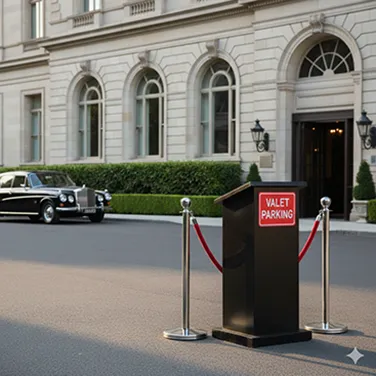
Valet Sign Placement for Hotels and Event Venues in Los Angeles: The Complete Setup Guide
Category: Valet Parking | Read time: 7 min
Hotels and event venues in Los Angeles face a valet challenge that restaurants typically don’t: large volumes of guests arriving simultaneously, complex property layouts, and the need to manage both drop-off and self-parking simultaneously.
A restaurant may handle 20 valet cars on a busy Friday night. A hotel handles that many before noon. An event venue may have 300 cars arriving within the same 45-minute window. In these environments, valet signage isn’t just helpful — it’s operationally essential.
Hotels: Building a Permanent Valet Signage System
Hotels with full-time valet operations need a permanent, weather-resistant signage system — not portable A-Frames that blow over in Santa Ana winds or fade in the Southern California sun. Here’s how to build it zone by zone.
Street-Level Approach Signs
Guests arriving at a hotel are often tired, unfamiliar with the area, or distracted by traffic. Your street-level signs need to be large, clear, and positioned well in advance of the entrance.
For hotels on major Los Angeles streets (Wilshire, Sunset, Olympic, La Cienega, etc.), the recommended approach is:
- Place a primary “Valet Parking” sign visible from at least 75–100 feet in both directions of travel
- If your hotel has a driveway that’s not immediately visible from the street, add a directional sign at the nearest intersection
- For hotels with multiple entrances, post signs at each active entrance indicating which entrance leads to valet
Porte-Cochère and Drop-Off Zone
The porte-cochère (the covered drive-through entrance common in hotels) is where most of your valet signage activity happens. A well-signed hotel porte-cochère should include:
- “Valet Parking — Please Stop Here” at the primary stopping point
- “Please Pull Forward” signs along the lane for queue management during peak arrivals
- “Do Not Enter” at the exit end of the porte-cochère to prevent wrong-way entries
- “No Parking — Valet Zone” signs along the full length of the drop-off area
- Valet fee display if applicable, at eye level near the podium
For hotels with 24-hour valet operations, all signs in the porte-cochère should use reflective materials or be illuminated — nighttime visibility is non-negotiable.
Self-Parking vs. Valet Separation
Many hotels offer both valet parking and a self-parking garage. Clear separation of these two options at the entrance is critical. Guests who want to self-park should be diverted before they reach the valet zone — not after.
What to place at the entrance decision point:
- “Valet Parking →” and “Self-Parking ←” signs (or appropriate directional arrows for your layout)
- These signs should be at the same decision point — not one sign 50 feet before the other
- Height: mounted high enough to be visible over the roofline of an SUV
💡 Common Hotel Mistake
- Placing the self-parking sign after the valet zone entrance — guests are already in the valet lane when they see it.
- The solution: place both options (valet and self-park) at the same decision point, before either lane begins.
Overnight and Long-Term Valet Signage
Hotels with overnight valet guests should post signs at the valet podium communicating:
- Overnight valet rates (if different from hourly)
- Vehicle retrieval request time (“Please allow 15 minutes for vehicle retrieval”)
- Contact information for after-hours retrieval
- Any EV charging options available (increasingly expected in LA)
Event Venues: Managing High-Volume Arrivals
Event venues — banquet halls, wedding venues, concert venues, corporate event spaces — face the most demanding valet signage challenge: hundreds of cars arriving in a concentrated time window, driven by people who have never been to the venue before.
Pre-Arrival Directional Signage
For major events, consider temporary directional signs placed at key intersections on the approach routes to your venue. In Los Angeles, where GPS often routes guests via residential streets or indirect paths, advance directional signs prevent confusion before guests even reach your property.
Work with your valet operator to identify the 2–3 most common approach directions and place signs at those key turn points.
Multi-Lane Entry Configuration
High-volume events often require multiple simultaneous drop-off lanes. Your signage needs to direct drivers into the correct lane before they enter the drop-off area:
- “Valet — Lane 1” and “Valet — Lane 2” signs at the lane split point
- A traffic controller (person or arrow sign) at the split to actively direct vehicles
- “Full — Please Use Next Lane” signs for when one lane reaches capacity
VIP and Accessible Parking Separation
Events often have VIP guests and guests with disabilities who need designated parking zones separate from general valet. Signs must clearly designate:
- “Reserved — VIP Valet” zone with appropriate access control
- “Accessible Parking” with ISA symbol and a compliant California accessible parking sign
- Pathways from each zone to the venue entrance, with directional signs if not immediately obvious
Vehicle Retrieval Management at Event End
The end of an event is the highest-stress moment for any valet operation. Hundreds of guests leaving simultaneously, all wanting their cars immediately. Signage can significantly reduce chaos:
- “Please Wait Here for Vehicle Retrieval” signs in a clearly designated waiting area, away from the active lane
- “Do Not Enter Retrieval Lane” signs to keep the lane clear for returning vehicles
- If you use a ticket system: “Please Have Your Valet Ticket Ready” sign near the retrieval podium
- Exit directional signs to guide retrieved vehicles out without blocking the retrieval lane
LADOT Valet Permits: What Hotels and Venues Need to Know
If your hotel or event venue uses any public curb space for valet drop-off or retrieval, you are required to obtain a Valet Parking Operator (VPO) permit from the City of Los Angeles.
The LADOT valet permit process includes:
- Initial review with LADOT Parking Meters Division
- Petition signatures from neighboring properties (for on-street valet zones)
- LAPD Board of Police Commissioners review for the VPO permit
- LADOT final approval and installation of official valet zone signs on the public curb
The private valet signs you purchase (A-Frames, vertical panels, directional signs) operate in addition to the LADOT curb signs — they guide guests through your property and manage your internal traffic flow. You need both.
💡 Key Reminder for Event Venues
- Occasional events may qualify for a temporary event valet permit rather than a full VPO permit.
- Contact LADOT Parking Meters Division early — the full VPO permit process takes several weeks.
- Operating valet on public curb space without a permit can result in citations and shutdown of your valet operation.
Sign Material Recommendations for Hotels and Venues
| Application | Recommended Material | Why |
| Permanent porte-cochère signs | Aluminum or ACM (Maxmetal) | Durable, weather-resistant, professional look |
| Outdoor directional signs | Aluminum or ACM (Maxmetal) with reflective sheeting | Visibility day and night, LA sun-resistant |
| Event A-Frames (temporary) | Heavy-duty A-Frame with ACM panels | Portable, wind-resistant, reusable |
| Podium signs | ACM (Maxmetal) or high-density plastic | Easy to clean, professional appearance |
| Lane markers / queue management | Vertical panel with rubber base (20lb) | Stable in wind, visible to approaching drivers |
Get Professional Valet Signs for Your Hotel or Venue
At SignifyLA, we manufacture valet signage for hotels and event venues across Los Angeles. From permanent aluminum signs for your porte-cochère to portable A-Frame event packages, we build to LA outdoor standards with fast local turnaround.
We also offer custom branded signs with your property’s logo and colors — creating a cohesive arrival experience from the street to the valet podium.
👉 Shop Valet Signs for Hotels & Venues
👉 Get a Custom Quote for Your Property
Note: This article is for informational purposes only. Permitting requirements and local regulations may change. Always verify current rules with the City of Los Angeles (LADOT) for your specific location.